Adoption is not the problem. Design is.
The most expensive misdiagnosis in AI right now: our team didn’t adopt it.
Compound helps Scaling CEOs implement the Human+AI Co-Operating Model of the future, today.
You can see where AI is going. You just don't yet know how to operate inside it. Adding more tools doesn't close the gap — and neither does another training. The gap lives at the seam between the team and the AI it's supposed to be using.
That seam is the operating model. Co-intelligence is what happens when your team and your AI work as one system, not two parallel tracks. Until you redesign the operating model to make that possible, every tool stalls and every dollar of headcount keeps showing up on the same line of the P&L.
of enterprise AI pilots fail to ship measurable value. The core gap is organizational, not technological.
of CEOs say their AI investments haven't produced significant cost or revenue benefit yet.
way companies adjusted to AI was education — not role redesign, not workflow redesign.
Not a list of complaints. The pattern we hear from every Scaling CEO who's sat with us across a clarity call.
You've bought the tools — Copilot, ChatGPT, something else — and the team still does the same work the same way.
You named someone internally to “lead AI” and nothing changed — the org didn’t change around them.
Revenue is climbing, but headcount math is climbing with it. Margins are compressing.
You can't point to a single measurable result from your AI spend over the last 12 months.
When a peer at Vistage / EO / YPO asks how you're handling AI, you don't have a real answer — you have a tool you bought.
Most AI work starts at Build. The Compound Sequence starts at Signal — because you can't build what you haven't designed, and you can't design what you haven't diagnosed. Learn each stage by running it on a real constraint inside your own business. The first sprint produces a measurable operational win in six to eight weeks — and every sprint compounds on the last.
Using the Signal frame, you identify the one operational problem where an agent can take over and where the return is clear enough that the sprint pays for itself.
You can't automate what you don't understand. This step maps the knowledge, context, and judgment the work actually requires — the foundation the agent gets built on.
The concrete output here is the Hybrid Accountability Chart — a working document that defines which tasks stay with your people, which move to agents, and who owns every handoff.
Compound hands your team a working spec. Your team builds the agent into the workflow it already uses — not a separate system that looks good in a demo and gets ignored by week three.
At sprint close, you have a clear read on what the agent is handling well, where it still needs a person, and what that difference translates to in time and cost.
Everything from Sprint One — the chart, the agent, the redesigned workflow — carries forward as the foundation for Sprint Two. Each sprint compounds the last.
A weekly conversation on the operating side of AI — for the CEOs who have to make it pay.

The most expensive misdiagnosis in AI right now: our team didn’t adopt it.

“What AI tool should I buy” is the question every operator starts with.

You run the framework inside your own company. We coach the system. Members learn the Sequence by sprinting it on real constraints — with the bench, the skills library, and the cohort behind them.
A working session where we orient you to the bench, surface your most valuable operational constraint, and scope your first sprint. Happens within 1–2 weeks of enrolling.
Weekly retros are where members bring active sprint problems for coaching and peer pressure-test. Monthly Strategic PowerUps teach the frameworks; monthly Tactical PowerUps teach the implementation patterns — how to build skills, wire workflows, and deploy agents. You learn it on the call, then you go run it. The rhythm is the program.
The Compound Bench: a living library of AI coaching agents — one for each stage of the Sequence, plus the next ones we build. The Skills Library: portable workflows you install into your own LLM stack and run end-to-end. Not workbooks — working tools. Both libraries grow as the framework evolves.
A working document — updated in-session — that maps what your people own, what AI handles, what's solved, and what's next. It evolves sprint by sprint. You keep it. It compounds as the org evolves.
Operationally mature mid-market CEOs running real sprints in real companies — at your scale, on your week. Async between sessions, in person at the Quarterly Cohort Gathering and the Annual Retreat.

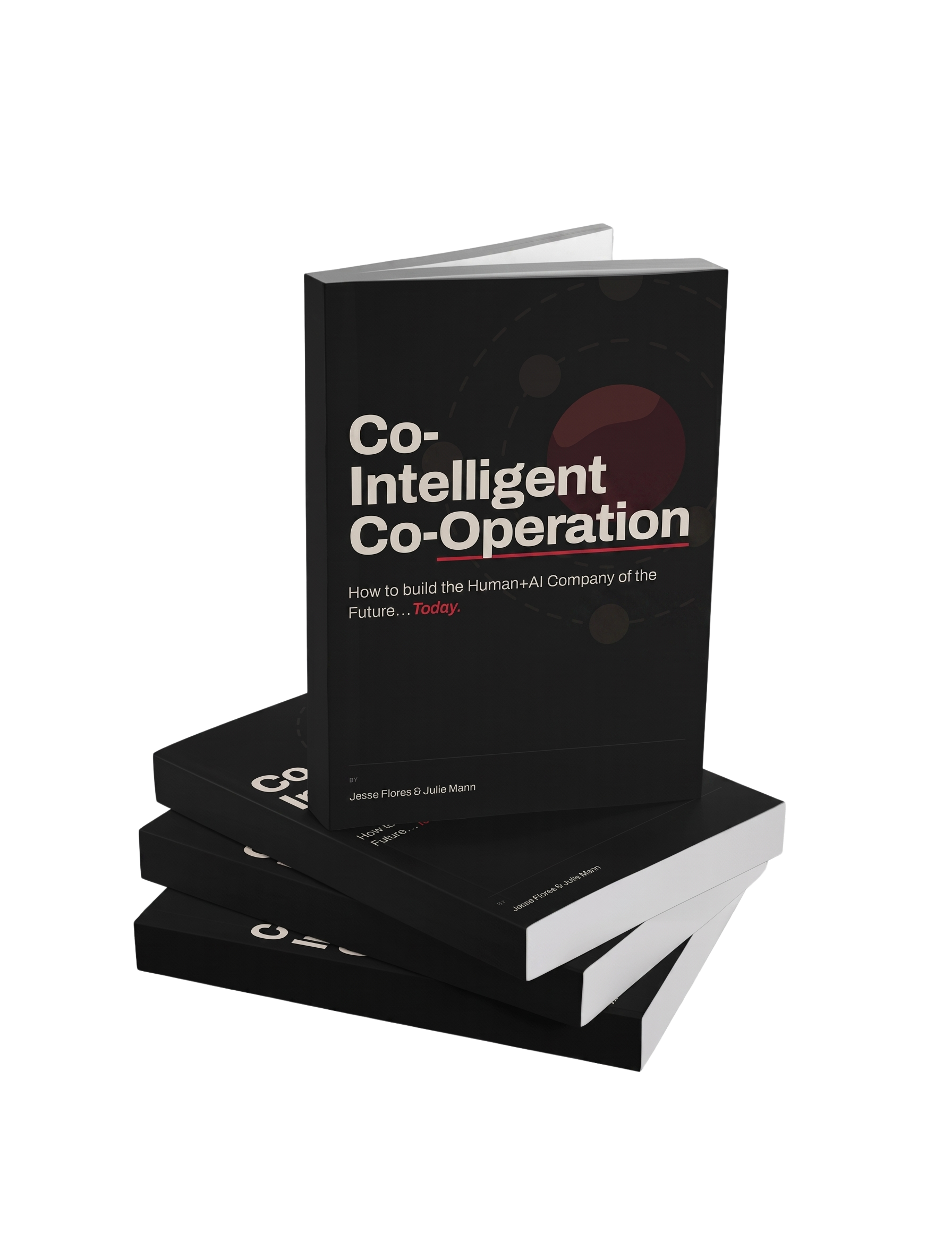
How to Build the Human+AI Company of the Future...Today. A free guide to installing the Co-Intelligent Operating Model inside your business — before you select another tool, hire another person, or run another pilot that goes nowhere.
Inside our own operations, we replaced two hires with AI workflows, captured the institutional knowledge of a senior employee before it walked out the door, and gave back eight hours a week of manual operations work. That's what we're teaching cohort members to build inside their own companies.

Built the Sequence inside his own company first. Replaced two hires with AI workflows and captured the institutional knowledge of a key employee before it walked out the door. Teaches the bench, the skills, and the build layer.

Brings the operating-model layer that the AI conversation has been missing: how teams actually change, and how a new rhythm gets installed without breaking the company. Teaches design, allocation, and deploy.
Compound is a fit if your business is already running on a system like EOS, Scaling Up, or Traction. If it isn't, we'll tell you on the call — and you'll leave with a clearer picture of the constraint than you walked in with.
$10–20M revenue, 25–150 employees, growing faster than the org can absorb.
You run on EOS, Scaling Up, Traction, or equivalent. The business OS works; the AI layer doesn’t.
You’ve already bought AI tools — and seen no measurable return on them.
Your largest operational constraint costs $150K or more per year — in dollars, compressed margin, or time.
Short field notes from inside active sprints. Each one is under three minutes. No theory — just what we found when we actually built it.
Thirty minutes. We put your operating model under scrutiny — name the constraint, source the headcount math, and tell you whether a sprint is a fit. If it isn't, you'll know exactly why. And if you run your first sprint and don't produce a measurable operational result, we refund the year.